THE SIMPLE PRESENT TENSE IS USED:
- To express habits, general truths, repeated actions or unchanging situations, emotions and wishes:
I smoke (habit); I work in London (unchanging situation); London is a large city (general truth) - To give instructions or directions:
You walk for two hundred meters, then you turn left. - To express fixed arrangements, present or future:
Your exam starts at 09.00 - To express future time, after some conjunctions: after, when, before, as soon as, until:
He'll give it to you when you come next Saturday.
Formation
FORMING THE SIMPLE PRESENT TENSE: TO THINK
NegativeI| Affirmative | Interrogative | |
|---|---|---|
| I think | Do I think? | I do not think |
| You think | Do you think? | You do not think |
| He thinks | Does he think? | He does not think |
| She thinks | Does she think? | She does not think |
| It thinks | Does it think? | It does not think |
| We think | Do we think? | We do not think. |
| They think | Do they think? | They do not think. |
EXAMPLES
- For habits
He drinks tea at breakfast.
She only eats fish.
They watch television regularly. - For repeated actions or events
We catch the bus every morning.
It rains every afternoon in the hot season.
They drive to Monaco every summer. - For general truths
Water freezes at zero degrees.
The Earth revolves around the Sun.
Her mother is Peruvian.
- For instructions or directions
Open the packet and pour the contents into hot water.
You take the No.6 bus to Watney and then the No.10 to Bedford.
To Describe future
- For fixed arrangements
His mother arrives tomorrow.
Our holiday starts on the 26th March - With future constructions
She'll see you before she leaves.
We'll give it to her when she arrives.
With future constructions
The present simple can be used to talk about talk about scheduled future events. These are events that happen according to a schedule or timetable. They are usually scheduled by someone else and they are usually public events.
Tomorrow is Friday.I fly to Paris next week.The plane departs at 8 p.m.The train to Ottawa leaves at 11:30 a.m.When do you leave for NYC?Her train arrives at 8:35 a.m. tomorrow morning.What time does the movie start tonight?What time do you finish work tomorrow?What time does the store open tomorrow?Final exams start next week.The concert begins at 6:30 p.m.The Monet exhibit closes on Sunday.The sale ends next week.
Important: Only the verbs below can be used in the simple present to talk about a future scheduled event:
- arrive
- be
- begin
- close
- depart
- end
- finish
- fly
- leave
- open
- start
Dynamic versus stative verbs
The most important reason you need to know about these is because stative verbs can't usually be used in the progressive form. But more about that later!
Firstly, what do the words "dynamic" and "stative" mean?
They aren't very common words in everyday English, but they are grammar terms you will need to know to understand this subject.
Dynamic
"Dynamic" is an adjective which means something is moving or changing.
In English grammar a "dynamic verb" means that the verb describes an action rather than a state. Dynamic verbs are sometimes known as "action verbs."
"Joe is chasing the bus."

Stative
"Stative" is an adjective which describes something as having a state, or existing (this is a very uncommon adjective).
In English grammar a "stative verb" means that the verb describes a staterather than an action.
Stative verbs are sometimes known as "state verbs."
"Kevin wants some ice-cream."
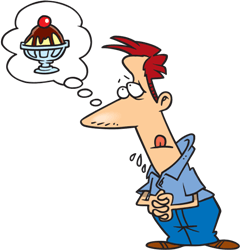
So now you know the meaning of the terms, let's look at some examples!
First, here is a list of some dynamic verbs. You can see that they are all used to describe an action, change, or process. Most of them are used to describe an activity which has a start and an end.
Examples of dynamic verbs:
- eat
- walk
- learn
- grow
- sleep
- talk
- write
- run
- read
- become
- go
These words can all be used in the progressive form.
Example sentences with dynamic verbs:
- "I can't talk right now, I'm eating dinner."
Present progressive used to describe an action happening now.
- "Sorry, I'm out of breath because I've been running."
Present perfect progressive used to describe an action that started in the past, continued for some time and has results now.
- "I didn't steal the necklace! I was sleeping when someone broke into the shop!"
Past progressive used to talk about an action that was happening at a particular time in the past.
Here is a list of some of the stative verbs. Some of these describe relationships between things or people (for example, own) and some describe emotions or states of mind.
Examples of stative verbs:
- love
- hate
- like
- prefer
- doubt
- seem
- know
- own
- understand
Here are some examples, showing that these words cannot be used in the progressive form.
Correct: "I like chocolate, but I prefer cake."
Incorrect: "I'm liking chocolate but I'm preferring cake."
Correct: "I don't understand you when you speak quickly."
Incorrect: "I'm not understanding you when you speak quickly."
There are also some verbs that can be either dynamic or stative, depending on their meaning and context in the sentence. I'm sure you know by now that there are many words in English that can have more than one meaning!
Examples of verbs that can be either dynamic or stative:
- think
- mind
- have
- smell
- sound
Let's look at some examples of how these verbs are used differently.
Example sentences:
- "I think it is wrong to hit children."
Here, think is a stative verb. It means "to have an opinion" and it cannot be used in the progressive form in this case.
BUT
"I'm thinking about buying a new car."
Here, thinking is describing a process, or an action. This is something that is happening, rather than simply being. So here we can use the progressive form.
- "I don't mind if we watch a movie tonight."
Here, mind means "be bothered by", which is a state of mind, not an action. Therefore, it is stative.
BUT
"I'm not being nosy. I'm minding my own business!"
Here, minding means "looking after" and is therefore a process and a dynamic verb.
- "I have three brothers."
Have here talks about the family relationship the speaker has with her brothers and is therefore stative.
BUT
"I'm having a bad day today. I'll call you when things are better."
Having in this sentence means the speaker is going through the process of a bad day. It is therefore dynamic.
All this may seem complicated, but if you read and listen to as much English as you can, you will soon start to know which verbs sound right in the progressive. If you keep the basic idea of dynamic verbs vs. static verbs in the back of your mind, it will help you greatly.
Now, let's practice!
Present progressive used to describe an action happening now.
Present perfect progressive used to describe an action that started in the past, continued for some time and has results now.
Past progressive used to talk about an action that was happening at a particular time in the past.
Here, think is a stative verb. It means "to have an opinion" and it cannot be used in the progressive form in this case.
BUT
"I'm thinking about buying a new car."
Here, thinking is describing a process, or an action. This is something that is happening, rather than simply being. So here we can use the progressive form.
Here, mind means "be bothered by", which is a state of mind, not an action. Therefore, it is stative.
BUT
"I'm not being nosy. I'm minding my own business!"
Here, minding means "looking after" and is therefore a process and a dynamic verb.
Have here talks about the family relationship the speaker has with her brothers and is therefore stative.
BUT
"I'm having a bad day today. I'll call you when things are better."
Having in this sentence means the speaker is going through the process of a bad day. It is therefore dynamic.

Dynamic verbs and stative verbs exercises
Reminder:
- Actions that are in progress now => present progressive
Example: We are walking right now.
- States that occur now => simple present
Example: We want to walk now.
Example: We are walking right now.
Example: We want to walk now.
Exercises
Dynamic verbs and stative verbs exercise 01
Dynamic verbs and stative verbs exercise 02
Dynamic verbs and stative verbs exercise 03
Dynamic verbs and stative verbs exercise 04
Dynamic verbs and stative verbs exercise 05
(Special exercise with verbs that have both dynamic and stative meanings)
Simple present instead of continues for state verb
Stative verbs
Some verbs are not usually used in the continuous form, even when we are talking about temporary situations or states. These are called stative verbs.
- So, we say I’m sorry, I don’t understand rather than
I’m not understanding.
1. Stative verbs are often verbs connected with thinking and opinions.
- She doesn’t know what to do NOT
She isn’t knowing what to do - Do you agree with me?
- I don’t recognise it, do you?
Other verbs in this group include: believe, doubt, guess, imagine, mean, remember, think
2. Other stative verbs are connected with feelings and emotions
- I like this song. Who sings it? NOT
I’m liking this song - What do you want to do now?
- I hate my new boss!
Other stative verbs in this group include: dislike, love, prefer. want, wish
NB – although ‘enjoy’ is a verb of emotion, it is used in the continuous tense
- I’m enjoying the party.
3. ‘see’, ‘hear’, ‘taste’, ‘smell’, ‘feel’ are verbs that describe senses.
These verbs aren’t usually used in continuous forms. They are often used with ‘can’.
- It smells of smoke in here. NOT
It’s smelling of smoke in here - I can’t see anything. It’s too dark.
4. Stative verbs describe things that are not actions.
Look carefully at these 2 sentences.
- He smells of fish.
- He’s smelling the fish.
The second sentence is an action – not a state. The man wants to know if the fish is OK to eat.
- I think we should go to Croatia for our holiday this year.
- Sorry, what did you say? I was thinking about my holiday.
The first sentence is an opinion but the second sentence is an action.
List of State verbs
Some English verbs, which we call state, non-continuous or stative verbs, aren't used in continuous tenses (like the present continuous, or the future continuous). These verbs often describe states that last for some time. Here is a list of some common ones:
Stative (or State) Verb List
| like | know | belong |
| love | realise | fit |
| hate | suppose | contain |
| want | mean | consist |
| need | understand | seem |
| prefer | believe | depend |
| agree | remember | matter |
| mind | recognise | see |
| own | appear | look (=seem) |
| sound | taste | smell |
| hear | astonish | deny |
| disagree | please | impress |
| satisfy | promise | surprise |
| doubt | think (=have an opinion) | feel (=have an opinion) |
| wish | imagine | concern |
| dislike | be | have |
| deserve | involve | include |
| lack | measure (=have length etc) | possess |
| owe | weigh (=have weight) |
A verb which isn't stative is called a dynamic verb, and is usually an action.
Some verbs can be both stative and dynamic:
| Be |
be is usually a stative verb, but when it is used in the continuous it means 'behaving' or 'acting'
|
| Think |
|
| Have |
|
| See |
|
| Taste |
Exceptions
sometimes you can use state verb in the continuous form
However, we can use the present continuous with a state verb if we want to emphasise that something is temporary or happening around the present time.
Examples:
Sentences (1) and (2) are about something that is a state. It is always true. It is something that does not change (we know that from "every day" and "in the spring").
Sentences (3) and (4) are about temporary situations. We know that from the phrases "these days" and "this year". Sentence (3) says that right now, I am loving my job, but that perhaps that could change in the future. Sentence (4) says that the cherry trees look especially good right now, but soon the flowers will fall and the season will pass.
|

No comments:
Post a Comment
please comment